
Beauty & OEM Skincare Insights
Expert guidance on Halal cosmetic manufacturing, private label skincare trends, and formula innovation.
Cutting-Edge Beauty Science & R&D Reports
Discover industry research, ingredient breakdowns, and strategic manufacturing advice.
Halal & GMP Compliance Guides
Learn how to build and scale competitive beauty brands in compliance with global market standards.
How to Find an Eco Friendly Cosmetic Manufacturer
Table of Contents
- Define Your Sustainability Requirements for Cosmetic Manufacturing
- Research Manufacturers with Verified Eco-Friendly Practices
- Evaluate Certifications, Ingredients, Packaging, and Supply Chains
- Assess Product Development, Safety, and Regulatory Capabilities
- Compare Proposals and Verify the Manufacturer Before Partnering
- FAQS
- Conclusion
- Related Posts
Choosing an eco-friendly cosmetic manufacturer takes more than scanning a website for green claims. The real evidence often sits in ingredient records, production controls, and packaging specifications. Look closer. Can the supplier trace key raw materials to their sources? Can it explain how it reduces water use, energy consumption, and production waste? Specific answers are more useful than broad promises.
Eco-Friendly Cosmetic Manufacturing is not a single process or universal standard. A responsible partner should be able to share relevant documentation, explain its quality checks, and describe how it keeps batches consistent. Request product samples and review ingredient, sourcing, and packaging details against your own needs. If possible, discuss production practices with the team or visit the facility. Small details matter: a refillable bottle is less useful if its pump cannot be replaced, and recycled packaging still needs to protect the formula.
No manufacturer has zero environmental impact. That deserves honest attention. The goal is to find a supplier that can show measurable progress, acknowledge limitations, and support clear communication over time. This guide explores practical questions to ask, records to review, and warning signs to consider before making a decision. Requirements and available certifications can vary by product and market, so verify claims with suitable documentation rather than relying on labels alone. A careful choice starts with evidence—and a willingness to ask one more question.
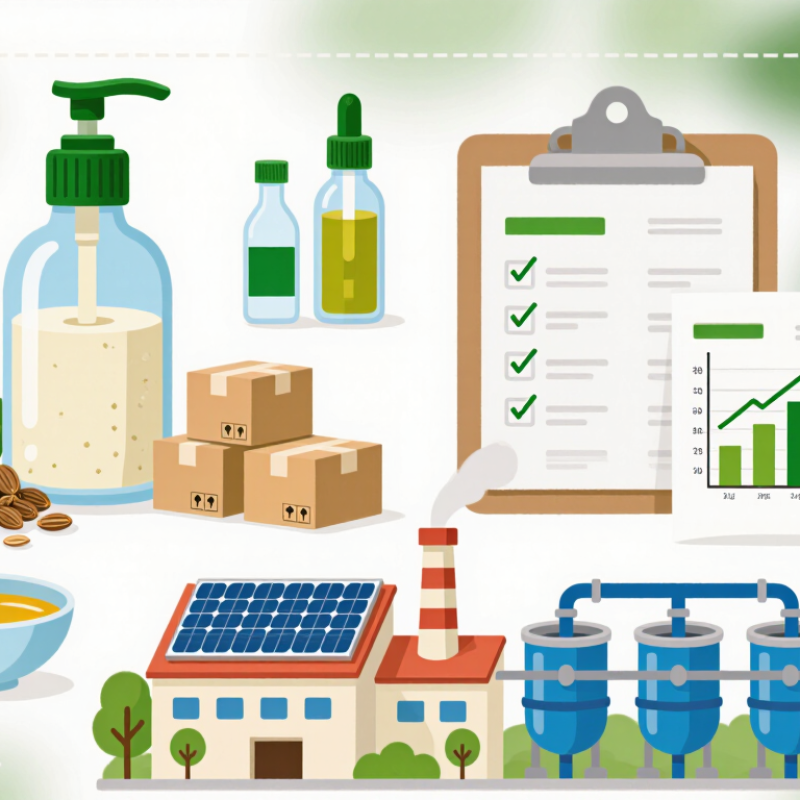
Define Your Sustainability Requirements for Cosmetic Manufacturing
Before contacting a cosmetic manufacturer, define what sustainability means for your products. Set measurable requirements for ingredient traceability, packaging materials, factory energy use, water consumption, and production waste. OECD’s Global Plastics Outlook (2022) estimates that only 9% of plastic waste was recycled globally in 2019. This makes packaging recovery worth discussing, but recycled content alone does not prove a package is recyclable locally. There is no perfect material choice: barrier performance, recycled content, and local collection can conflict.
Ask potential manufacturers for site-level records, not broad promises. Request recent energy, water, and waste data, plus details on how figures are measured and allocated to your orders. Check whether suppliers are assessed, corrective actions are tracked, and environmental claims have supporting documents. An environmental management certificate can help, but it is not a substitute for product-specific evidence. Small details matter. A lightweight bottle may still need extra protective packaging.
Tips: Send a short scorecard before requesting quotes. Ask for one real example of a completed improvement, such as reduced process water per production batch. Compare suppliers using the same boundaries, and note where data is estimated.
How to Find an Eco-Friendly Cosmetic Manufacturer
U.S. Packaging Material Recycling Rates (2018)
Use these national rates as context when defining packaging requirements with a manufacturer. They are not specific to cosmetic packaging; ask suppliers for material-specific recyclability data and local collection guidance.
Source: U.S. Environmental Protection Agency, 2018 recycling and composting data.
Research Manufacturers with Verified Eco-Friendly Practices
An eco-friendly claim is only useful when the manufacturer can show its work. Ask for a recent, site-specific environmental audit, not just a polished brochure. Request figures for energy and water use, waste, and emissions per unit produced. Check the reporting period and whether an independent party verified the data. McKinsey’s 2023 US survey on packaging found that 60% of consumers were willing to pay more for sustainable packaging. This indicates real market interest, but consumer demand does not prove a factory’s environmental performance.
Review the scope and expiry date of any environmental certification. Confirm that it covers the actual production site and relevant processes. Ask how the manufacturer tracks ingredient origins, packaging materials, wastewater, and waste disposal. Look for records, such as utility bills or audit findings, rather than broad promises. A certificate is not a complete answer; its scope may be narrow. And reports can leave gaps. Ask what is not measured, too.
Tips: Request a sample audit summary and compare its dates with current production records. Look beyond logos. If a supplier cannot explain a metric in plain language, ask for clarification before relying on it.
Evaluate Certifications, Ingredients, Packaging, and Supply Chains
An eco-friendly cosmetic manufacturer should document claims, not just display logos. Ask for current certificates, their scope, audit dates, and covered sites. One factory’s certificate may not cover every product. Standards such as COSMOS can help assess ingredient and processing criteria, while ISO 14001 addresses environmental management rather than product impact. Check ingredient origin, renewable content, biodegradability evidence, and supplier traceability. “Plant-based” alone proves little. Paperwork matters. A polished certificate can still leave gaps, so verify the details.
Packaging deserves a physical review. Request a sample and inspect its weight, closures, labels, and material layers; mixed components can complicate recycling. The OECD’s Global Plastics Outlook (2022) estimated that only 9% of plastic waste was recycled worldwide in 2019. Ask for recycled-content percentages, refill-system return rates, and evidence that packaging works with local collection systems. Lighter is not automatically better if it causes breakage or requires extra protective shipping.
Trace the supply chain beyond the factory gate. CDP’s 2020 Supply Chain Report found supplier emissions averaged 11.4 times companies’ direct operational emissions. That gap makes supplier data essential. Request energy and water figures, transport routes, labor-audit summaries, and corrective-action records. Compare figures across years, not just promises. One uncomfortable question remains: can the manufacturer show the same evidence for subcontractors? If not, that gap should count in your assessment.
How to Find an Eco-Friendly Cosmetic Manufacturer: Evaluate Certifications, Ingredients, Packaging, and Supply Chains
| Evaluation area | What to assess | Useful evidence to request | Questions and red flags |
|---|---|---|---|
| Certification scope | Check what a certification covers: the finished product, ingredients, manufacturing site, packaging, or environmental management system. | Current certificate, issuing body, covered products or facilities, validity dates, and the applicable standard. | Does the certificate apply to the product you plan to make, or only to a facility or one ingredient? Is the certificate current and independently verifiable? |
| Cosmetic product standards | Review standards such as COSMOS or NATRUE where relevant. Requirements and permitted ingredient categories differ by standard and product type. | Product-level certification or written confirmation of the certification pathway, ingredient documentation, and compliance requirements. | Is the product actually certified, or merely described as “certifiable,” “natural,” or “inspired by” a standard? |
| Environmental management | Assess how the manufacturer manages site-level impacts, such as energy, water, waste, and environmental compliance. | An environmental management system certificate, such as ISO 14001, plus site-specific performance data and improvement goals. | ISO 14001 applies to an environmental management system; it does not by itself certify a cosmetic product as eco-friendly. Are measurable results available? |
| Ingredient transparency | Review the complete ingredient list using INCI names, ingredient functions, and available sourcing or processing information. | Formula documentation, current supplier specifications, safety documentation, and ingredient origin information where available. | Can the manufacturer explain each ingredient’s purpose and disclose relevant trade-offs? Avoid treating “natural” as proof of safety or lower environmental impact. |
| High-impact and sensitive ingredients | Identify ingredients with sourcing, biodiversity, allergen, or environmental concerns relevant to the formula and market. | For palm-derived materials, request traceability and applicable RSPO supply-chain documentation. For other materials, request origin and risk-management details. | Are claims about sustainable sourcing supported by records? Do not assume a certification or sourcing claim covers every derivative or ingredient in a formula. |
| Packaging materials | Assess material type, packaging weight, recycled content, component count, and whether parts can be separated for disposal. | Material specifications, recycled-content documentation, packaging drawings, and disposal guidance for the intended sales markets. | Is “recyclable” accurate for the complete pack and local collection systems, or only for a component? Are labels, pumps, coatings, or mixed materials likely to complicate sorting? |
| Refill and reuse options | Compare refill or reusable formats with the standard pack, including material use, transport, cleaning, and the number of expected uses. | Lifecycle or comparative assessment assumptions, refill-system instructions, and evidence that customers can practically reuse the pack. | Does the reuse system reduce impacts in realistic use, or does that claim depend on an unverified number of refills? |
| Packaging claims and chain of custody | For paper-based packaging, check whether a claim relates to responsible sourcing and whether chain-of-custody documentation covers the supplied material. | Relevant FSC chain-of-custody records or other applicable sourcing documentation, along with clear claim wording and scope. | Does the documentation cover the specific packaging component and supplier? Avoid relying on a logo or claim without checking its scope. |
| Supply-chain traceability | Map the manufacturing site, key ingredient suppliers, packaging suppliers, and any higher-risk sourcing regions. | Supplier list or anonymized supplier map, country-of-origin information where available, traceability procedures, and change-control records. | Can the manufacturer identify the origin and supplier tier for priority materials? How are substitutions and sourcing changes communicated? |
| Labor and supplier oversight | Review policies and processes for worker rights, health and safety, grievance handling, and supplier monitoring. | Supplier code of conduct, audit approach, corrective-action process, and appropriately redacted audit or monitoring summaries. | Are audits risk-based and followed by corrective action? A policy alone does not demonstrate that working conditions are monitored. |
| Manufacturing operations | Ask how the site tracks energy, water use, waste, wastewater, and production losses, and whether it has reduction targets. | Recent site-level metrics, measurement boundaries, target dates, and progress records. Check that data refers to the relevant facility. | Are figures measured or estimated? Are claims supported by a baseline, a defined period, and a clear reporting boundary? |
| Final due diligence | Compare manufacturers against the same criteria and prioritize verifiable product, site, and supply-chain evidence. | A completed supplier questionnaire, document review, sample evaluation, and written agreement covering claims, specifications, and change notifications. | Can the manufacturer provide evidence before launch and maintain it through production? Treat broad environmental claims without defined scope as a reason to ask for clarification. |
Evaluation tip: Verify each claim against its scope, date, and supporting documents. Certification, ingredient origin, and packaging recyclability can vary by product, supplier, and market.
Assess Product Development, Safety, and Regulatory Capabilities
An eco-friendly cosmetic manufacturer should be able to explain how it develops, tests, and adjusts a formula. Share your target texture, packaging, ingredient preferences, and expected shelf life. Ask whether the team can make a pilot batch and assess stability under different temperatures. Packaging compatibility matters too: a botanical lotion may separate or discolor in a container that seems suitable on paper. Small details matter. I would not treat “natural” ingredients as automatically safer or more sustainable; their sourcing and performance need evidence.
Ask for written safety procedures and test records relevant to your product, such as microbiological testing for water-based formulas. Find out who reviews ingredient restrictions and labeling for each market where you plan to sell. A capable partner should describe its process clearly, identify documentation it can provide, and flag limits early. Be cautious if answers stay vague. No manufacturer can promise that every formula will suit every user.
Tips: Request a sample batch, a sample product specification, and an outline of regulatory support before committing. Check that documents match the actual formula and packaging. If a supplier cannot explain a test result in plain language, pause and ask again. That extra conversation can be awkward, but it may reveal a gap worth addressing.
Compare Proposals and Verify the Manufacturer Before Partnering
Compare proposals against the same written brief, not just the quoted price. Check minimum order quantities, lead times, formula development fees, packaging options, and what testing is included. A low unit cost may exclude stability checks or incoming-material inspections. Ask each manufacturer to identify ingredient origins and explain how they assess suppliers. For environmental claims, look for measurable details: recycled content percentages, refill compatibility, or energy-use data. Broad phrases like “green production” are difficult to compare.
Ask for evidence. Request current certificates and confirm which site, processes, and product categories they cover. A certificate may not apply to every factory or formula. Check sample batches for texture, scent consistency, and packaging performance, then review quality records and traceability procedures. If possible, tour the facility or arrange an independent assessment.
Check the details. Ask how the manufacturer handles production waste, wastewater, and rejected batches, and request references from comparable projects.
I would not treat a polished proposal as proof; it is easy to focus on attractive packaging and overlook practical gaps. Put agreed specifications, quality checks, and change-approval steps in writing before committing. If answers stay vague, pause and ask again.
FAQS
Set measurable targets for ingredient traceability, packaging, energy, water, and production waste. Use the same scorecard for every supplier.
Request recent site-level energy, water, and waste data. Ask how figures are measured and assigned to your orders. Estimates should be clearly marked.
No. Local collection systems, material layers, and sorting options affect recyclability. Only 9% of plastic waste was recycled worldwide in 2019, according to the article.
Review each certificate’s scope, audit date, and covered site. One factory’s certificate may not apply to every product. Paperwork matters.
Check the bottle’s weight, closure, label, and material layers. Mixed materials can complicate recycling. A lightweight bottle may still need extra protective packaging.
Ask for supplier traceability, transport routes, energy and water figures, labor-audit summaries, and corrective-action records. Check whether subcontractors provide the same evidence.
Request a pilot batch and stability checks at different temperatures. Test whether the formula works with the actual packaging. Natural does not automatically mean safer.
Request written safety procedures, relevant test records, and an outline of market-specific labeling support. Documents should match the formula and packaging. Vague answers deserve another question.
Conclusion
Choosing an eco-friendly cosmetic manufacturer begins with defining what sustainability means for your products. Set clear priorities for ingredients, packaging, energy use, waste reduction, and sourcing, then use them to research potential partners. Look for manufacturers that can explain their environmental practices and provide credible documentation rather than relying on broad claims. Compare their certifications, ingredient policies, packaging options, and supply-chain transparency to understand how their commitments are put into practice.
Sustainability should also work alongside product quality and safety. Assess each manufacturer’s capabilities in formulation, testing, production, and regulatory support, and ask how these processes are documented. Request detailed proposals that cover costs, timelines, materials, and production methods, then verify important claims through records, references, or an independent review where appropriate. A careful evaluation helps you select a partner whose approach to Eco-Friendly Cosmetic Manufacturing aligns with your requirements and can support consistent, responsible production over time.

Blog Tags: